For more than 30 years we have turned paper and board into advertising that works — and we have spent the last ten reducing what that costs the environment. From four production sites we serve customers across Europe, and every one of them can now see our full carbon footprint, measured and published in detail.
We corrugate our own board. Corrugated board is mostly air, which makes it expensive to move. Because we produce ours on site, what arrives at our plants is reels of paper rather than finished board — roughly one truck where four would otherwise be needed.
We sheet our own paper. With our own sheeting line and a range of reel widths held in stock, we cut to size on one dimension instead of two. Less trim waste means less paper bought, less waste hauled away, and a lower footprint in every finished product.
Together these two decisions act directly on our two largest sources of emissions: the paper we buy and the transport it takes.
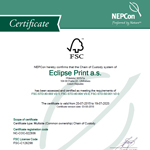
Certified fibre. We source from FSC® and PEFC certified paper mills, and our group holds FSC® Multisite certification covering posters, POS material and packaging.
Paper first. We offer a full range of substrates, including plastic boards — and for every one of them a paper-based, fully recyclable alternative. We bring that option up at the design stage, while switching is still easy and inexpensive. Our standard corrugated products are fully recyclable at end of life.
Ten years of cleaner printing. Successive investments have replaced solvent-based printing with water-based, latex and UV-curable ink systems, cutting solvent consumption and VOC emissions. In late 2025 we took over an adjacent hall at our Slovenian site with a rooftop solar array; its output will be reflected in our 2026 figures.
| Eclipse Group, 2025 | tCO2e |
|---|---|
| Scope 1 — own operations | 586.520 |
| Scope 2 — purchased energy (market-based) | 1,856.043 |
| Scope 3 — value chain, all 15 categories screened | 6,386.355 |
| Total | 8,828.918 |
| Production output | 9,303.70 t |
| Intensity | 0.949 tCO2e per tonne |
Scope 2 on a location-based basis is 1,126.630 tCO2e, disclosed separately and not included in the total above. Scope 1 and 2 follow the GHG Protocol Corporate Standard and Scope 2 Guidance; Scope 3 follows the Corporate Value Chain Standard. We publish the complete inventory rather than a headline figure: boundary, category-by-category results, methods and evidence. Our customers can take these numbers straight into their own Scope 3 reporting.
Where we are going.
|
Target |
Baseline 2025 |
Target |
|---|---|---|
|
Emissions intensity |
0.949 tCO2e per tonne |
0.664 tCO2e per tonne by 2030 (−30 %) |
|
Absolute Scope 1 + Scope 2 (market-based) |
2,442.563 tCO2e |
1,221.3 tCO2e by 2030 (−50 %) |
|
Electricity intensity |
332.60 kWh per tonne |
299.3 kWh per tonne by 2030 (−10 %) |
|
Renewable and zero-carbon electricity |
residual mix |
100 % by 2030 |
|
VOC emissions per tonne |
2025 baseline |
−20 % by 2030, measurement at all sites by end 2027 |
|
Water withdrawal |
0.879 m3 per tonne |
0.747 m3 per tonne by 2030 (−15 %) |
|
Waste |
252.73 kg per tonne |
227.5 kg per tonne by 2030 (−10 %), recovery kept at 90 % or above |
|
Certified fibre |
— |
100 % FSC or PEFC certified paper and board by 2030 |
These targets are approved by group management and reviewed every year. Our progress is published in the same place as the figures above.
Documents: Eclipse Group GHG Performance Disclosure 2025 (REG-GROUP-S-004, v2.2) · GHG Targets and Transition Plan (PLAN-GROUP-S-002, v1.0) · Environmental Policy (POL-GROUP-S-001, v2.0) · FSC® Certificate FSC-C126298